EMS Training Before and After Results
You do not need another fitness promise that sounds good on Monday and disappears by Friday. When people search for ems training before and after, they usually want one thing - proof that a short, structured workout can lead to real change in the mirror, in their energy, and in how they feel day to day.
That proof is real, but it is not magic. EMS training can speed up consistency, muscle activation, and training efficiency. What happens before and after depends on your starting point, how often you train, how well you recover, and whether your food matches your goal. If you want visible change without spending hours in the gym, this is where EMS makes sense.
What EMS training before and after really means
Most people imagine dramatic photos when they hear ems training before and after. Photos matter, but they only show part of the story. The better question is this: what actually changes, and when?
In the early stage, the biggest shift is often not visual. It is how your body responds to training. Muscles switch on harder. Sessions feel more focused. You finish in 20 minutes feeling like you have genuinely worked. For busy adults who have struggled to stay consistent, that change matters more than hype. A plan you can stick to beats an ideal routine you never do.
After that, physical changes start to build. Some people notice better muscle tone first, especially around the core, glutes, legs, and arms. Others notice posture, tighter-feeling clothing, or improved energy before the scales move. If fat loss is the goal, the mirror and tape measure often tell the story better than body weight alone.
Before you start: set the right expectations
EMS is efficient, not effortless. That distinction matters.
A lot of before-and-after disappointment comes from expecting a shortcut that replaces all movement, all recovery, and all nutrition awareness. EMS can intensify muscle contractions and make short sessions highly effective, but results still come from repetition. Two or three quality sessions a week, done consistently, will usually outperform a burst of daily enthusiasm followed by nothing.
Your starting point also changes the timeline. If you are returning to exercise after months of inconsistency, your first improvements may come quickly. If you already train regularly, the changes might be more subtle at first, such as better muscle engagement or time efficiency. Neither is better. It is simply a different baseline.
EMS training before and after: what changes first?
The first two weeks are often about feeling. You may notice stronger contractions, better awareness of muscle groups, and post-workout fatigue that feels different from a standard home session. Some people also feel more motivated because the workout feels guided and structured rather than vague.
By weeks three to six, visible changes often begin. This is where people commonly report firmer muscles, a more lifted shape through the glutes and midsection, and a leaner look if nutrition is in check. Daily energy can improve too, especially for people who have been stuck in the cycle of sitting all day and skipping exercise because there is never enough time.
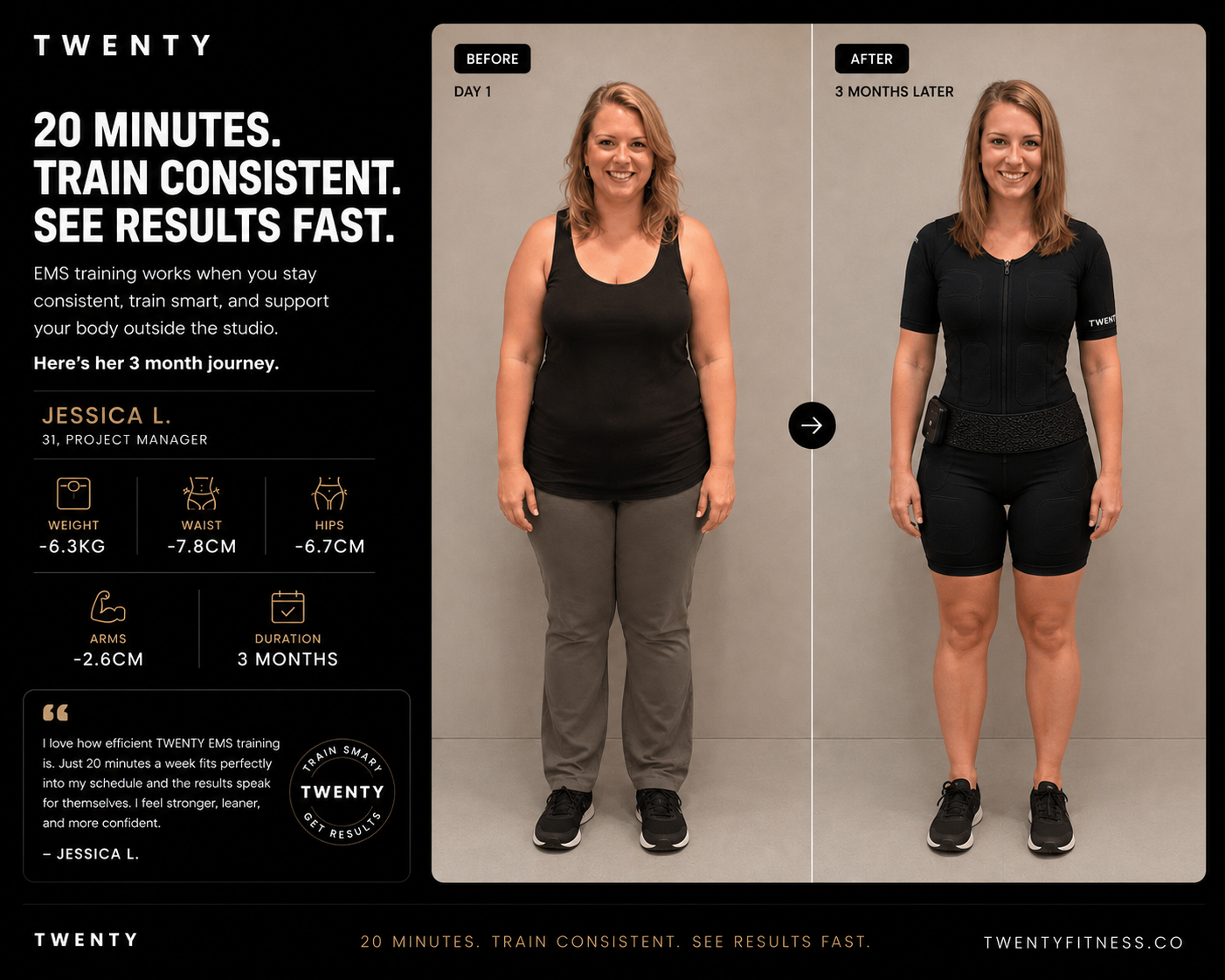
From six to twelve weeks, the before-and-after effect becomes clearer. This is where consistency compounds. Muscle tone is more noticeable. Waist measurements may drop. Strength in bodyweight movements can improve. Even if your total training time is low, your body starts to look like it has been getting regular, purposeful work.
That said, it depends on your goal. If you want fat loss, your food choices and overall calorie balance still matter. If you want muscle definition, intensity and progression matter. If you want better fitness and energy, regularity matters most.
The results people usually notice
Visible results get attention, but the strongest before-and-after stories are usually built on a few changes happening together.
One is muscle tone. EMS training is known for strong muscle activation, which can help create a firmer, more defined look when used properly. Another is posture. When the core and back are trained consistently, people often stand differently, sit better, and look more confident without even thinking about it.
There is also the time factor. For many adults, the real transformation is finally having a training method that fits around work, family, travel, and everything else. That removes the stop-start pattern that ruins progress. No time? No excuses only works if the system actually suits real life. This one does.
What a realistic timeline looks like
A realistic timeline is more useful than an exaggerated promise.
In the first one to two weeks, expect adaptation. You are learning the sensations, adjusting the intensity, and building the habit. In weeks three to six, expect early visible change if you are training consistently and eating with some purpose. In weeks eight to twelve, expect stronger before-and-after differences in shape, tone, and how your clothes fit.
Can some people see quicker changes? Yes, especially if they are starting from low activity levels and suddenly become consistent. Can it take longer? Also yes, particularly if stress, sleep, and food are working against you. Progress is rarely perfectly linear.
Why some before and after transformations look dramatic
The dramatic transformations usually come from a combination of factors, not EMS alone.
First, consistency improves because sessions are short and easier to fit in. Second, muscle recruitment is high, so the body gets a strong training signal in less time. Third, many people who start EMS also clean up their routine elsewhere. They drink more water, move more during the day, and eat with more intention because they finally feel momentum.
That momentum matters. When workouts stop feeling like a burden, people keep going long enough to see change.
How to make your own EMS training before and after results better
If you want your before-and-after photos to mean something, focus less on perfection and more on repeatable habits.
Train two or three times a week and treat those sessions as non-negotiable. Push the intensity to a level that feels challenging but controlled. Use progression rather than staying comfortable. If your app or programme allows muscle group and mode adjustments, use them to match your goal instead of repeating the same generic session every time.
Support the training with basics that still matter. Get enough protein. Drink enough water. Sleep properly when you can. Walk more. None of this is glamorous, but it is what makes the visual results appear faster and last longer.
It also helps to track progress properly. Take photos in the same lighting, the same clothing, and the same posture every two weeks. Measure your waist, hips, thighs, or arms if those areas matter to you. A single weigh-in can miss progress that is obvious everywhere else.
Common reasons results stall
When people feel disappointed by EMS, the cause is usually not the technology. It is the gap between effort and expectation.
One common issue is undertraining. If the intensity stays too low because you never move beyond the comfortable setting, the stimulus may be too mild. Another is inconsistency. One strong session followed by a week off will not produce much change. Nutrition can also blunt results, particularly if fat loss is the goal and food intake stays unchecked.
Recovery matters too. Muscles need a reason to adapt, but they also need time to recover. More is not always better. For many people, a smart rhythm beats an aggressive one.
Who tends to get the best results?
Busy people who need structure tend to do very well with EMS. So do those who want efficient strength and toning work without spending hours in a gym. Parents, professionals, and frequent travellers often respond best because the format removes friction.
People who already enjoy long gym sessions may still benefit, but for a different reason. EMS can complement what they already do by adding focused activation and variety. The point is not that every training method must be replaced. The point is that results come faster when training is practical enough to keep happening.
For someone using a smart, guided system such as TWENTY Fitness, that practicality becomes a major advantage. The easier it is to start, adjust, and finish a proper session at home, the harder it becomes to fall back into excuses.
The before and after that matters most
Yes, people care about flatter waists, firmer legs, stronger glutes, and more defined arms. That is normal. But the most powerful shift is often this: before, exercise felt like another thing you were failing to keep up with. After, it becomes part of your week without draining your time or your willpower.
That is where real transformation starts. Not with a perfect photo. With a system you can actually live with, week after week, until the mirror finally catches up with the effort.
If you are looking at your own ems training before and after journey, think bigger than the first photo. Give it structure, give it a few weeks, and let consistency do the work that motivation alone never could.