How Does EMS Training Work?
You have 20 minutes, a packed diary, and enough false starts behind you to know that good intentions are not a training plan. That is exactly why so many people ask, how does EMS training work? The short answer is simple: it uses controlled electrical impulses to activate your muscles more intensely during exercise, so you can get more from less time.
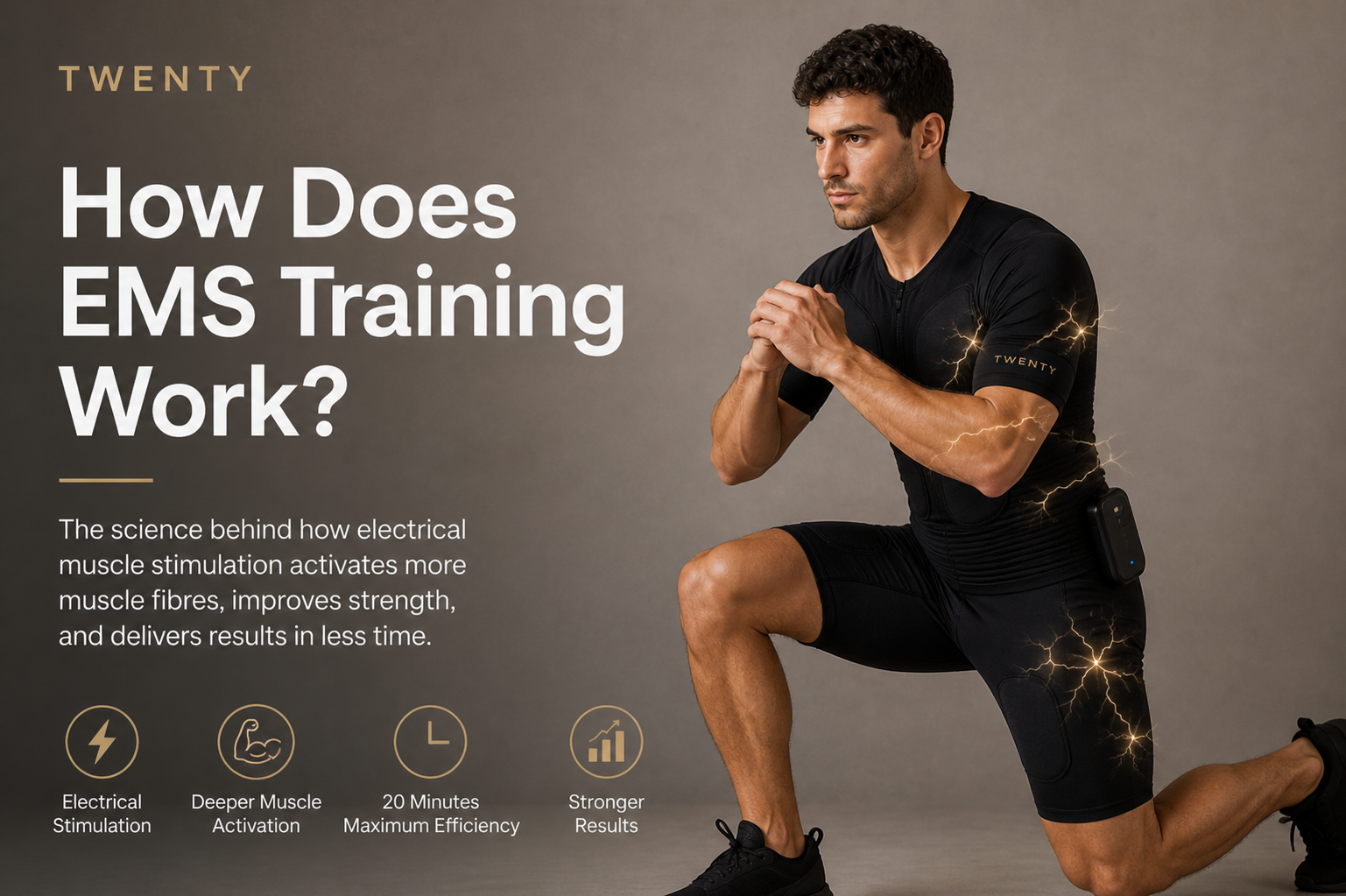
That sounds futuristic, but the idea is actually straightforward. EMS stands for Electrical Muscle Stimulation. In an EMS workout, a suit or set of pads sends low-frequency impulses to specific muscle groups while you move through guided exercises. Those impulses mimic the signals your brain normally sends to your muscles, prompting deeper and more consistent contractions.
The result is not magic, and it is not passive fitness. You still train. You still move. You still need consistency. What changes is efficiency. Instead of relying only on voluntary muscle activation, EMS adds another layer of stimulus, helping more muscle fibres engage during each movement.
How does EMS training work in practice?
An EMS session usually starts with putting on a fitted suit designed to target major muscle groups such as the legs, glutes, core, back, chest and arms. In modern systems, the suit connects to an app or control unit that allows you to adjust intensity, choose muscle groups and select a training mode based on your goal.
Once the session begins, the suit delivers pulses in timed intervals. You might feel a firm buzzing or tapping sensation across the muscles being targeted. Then you perform movements - squats, lunges, presses, core holds, light cardio drills or recovery work - while the impulses are active.
This matters because your muscles are being asked to do two jobs at once. They are responding to your movement, and they are responding to the electrical stimulation. That combination can increase recruitment, especially in areas people often struggle to engage properly on their own, such as the glutes, core or upper back.
What the electrical impulses actually do
Every muscle contraction begins with an electrical signal. Normally, your nervous system sends that signal from the brain to the muscle. EMS training adds an external impulse through electrodes built into the suit. That impulse triggers the muscle to contract, much like it would during regular exercise.
The key difference is reach and intensity. During a standard workout, not every available muscle fibre is recruited equally, especially if you are tired, untrained or rushing through a session. EMS can help create a stronger, more comprehensive contraction pattern. For many users, that means workouts feel more focused, more demanding and more productive despite being shorter.
It is also why 20 minutes can feel surprisingly hard. When multiple major muscle groups are stimulated at once, the body is working under a high training load even if the movements themselves are low impact.
Why EMS feels different from a normal workout
The biggest surprise for first-time users is that EMS does not feel like lifting weights, but it does feel like training. You are not relying on heavy external load to create resistance. The resistance comes from the muscle contraction itself.
That makes EMS especially appealing for people who want intensity without spending an hour in the gym or hammering their joints. A session can be challenging without being complicated. You do not need to queue for machines, plan a split routine or build your day around travel time.
That said, different goals still need different settings. A fat-loss focused session may use a different rhythm and intensity than a muscle-building one. A recovery or relaxation mode will feel different again. Good EMS systems let you tailor that experience instead of forcing one type of workout onto everyone.
Can EMS help with muscle tone, fat loss and fitness?
Yes, but the honest answer is that it depends on how you use it.
EMS can support muscle tone because stronger contractions mean your muscles are being challenged in a concentrated way. It can support fat loss because short, intense sessions help raise training demand, and because a practical routine is easier to stick to than one that never fits your life. It can support general fitness because it gets you moving regularly and trains multiple muscle groups in one go.
But EMS is not a replacement for basic physiology. If your nutrition is chaotic, your sleep is poor and you only train once every few weeks, the suit will not do the work for you. Results still come from repeated effort. The advantage is that EMS lowers friction. It makes high-quality training easier to fit into real life.
For busy adults, that is often the difference between another abandoned plan and something they can actually sustain.
How often should you do EMS training?
More is not always better. Because EMS sessions can be intense, most people do well with a few sessions per week rather than daily use at full power. Your ideal frequency depends on your starting point, recovery, goals and the intensity level you choose.
If you are new, starting conservatively makes sense. Let your body adapt. Learn what the sensations mean. Focus on proper movement and gradually increase intensity rather than trying to prove something in session one.
If you are more experienced, EMS can be used as a serious training tool alongside walking, mobility work, running or conventional strength sessions. It does not have to replace everything. For some people, it becomes the main method. For others, it is the most efficient piece of a wider routine.
Is EMS training safe?
For most healthy adults, EMS is generally safe when used properly and with sensible intensity. The important part is using quality equipment, following guidance and respecting recovery.
Like any training method, it is not suitable for everyone. People with certain medical conditions, implanted electrical devices or specific health concerns should get medical advice before starting. It is also important not to confuse effective intensity with reckless intensity. Stronger is not automatically better if your technique falls apart or you cannot recover well.
Done properly, EMS should feel controlled, deliberate and adjustable. You are meant to be challenged, not overwhelmed.
Who gets the most out of EMS?
The people who benefit most are often the ones who do not have hours to spare but still care deeply about looking, feeling and performing better. That includes professionals who work long days, parents fitting workouts around family life, frequent travellers, and anyone tired of the stop-start cycle that comes with time-heavy fitness plans.
EMS also suits people who want guidance. Instead of guessing which machine to use or trying to piece together a plan from random videos, they can follow a more structured, app-led experience.
That does not mean EMS is only for beginners. It can also appeal to experienced exercisers who want to add another stimulus, improve activation or make home training more effective. The appeal is broad because the core promise is broad - better efficiency without unnecessary complication.
The biggest misconception about EMS
The biggest myth is that you can stand still and somehow get the same result as proper training. That misunderstanding has followed EMS for years.
Good EMS training is active. You move through exercises. You stabilise. You control posture. You work through intervals. The electrical impulses make the work harder and more targeted, but they do not replace effort.
A better way to think about it is this: EMS compresses training. It helps your body work harder within a shorter window. That is why systems like TWENTY Fitness are built around guided 20-minute sessions rather than endless, passive stimulation.
So, how does EMS training work for real life?
It works by reducing the gap between knowing you should train and actually doing it. It turns a workout from a major event into something that can fit between meetings, before the school run or at the end of a long day without needing a full gym set-up.
And that is why EMS keeps growing. Not because people have become lazy, but because they have become realistic. Time matters. Energy matters. Convenience matters. If a training method can help activate more muscle, create serious intensity and fit inside a life that is already full, it earns attention.
The smartest fitness plan is not the one that looks hardest on paper. It is the one you can keep showing up for, even when life is busy.