Is a 20 Minute EMS Workout Enough?
You do not need another fitness plan that looks good on Sunday and falls apart by Wednesday. That is exactly why the 20 minute EMS workout has caught attention. It fits into a lunch break, before the school run, or at the end of a long day, and it is built around one promise busy people actually care about - getting more from less time.
The appeal is obvious, but the real question is whether 20 minutes is genuinely enough. For many people, the answer is yes, with a few important conditions. EMS training can make a short session feel far more demanding than its length suggests because the electrical impulses stimulate muscle contractions while you move through guided exercises. You are not simply trimming a normal workout down. You are changing how hard your muscles work within that time.
How a 20 minute EMS workout works
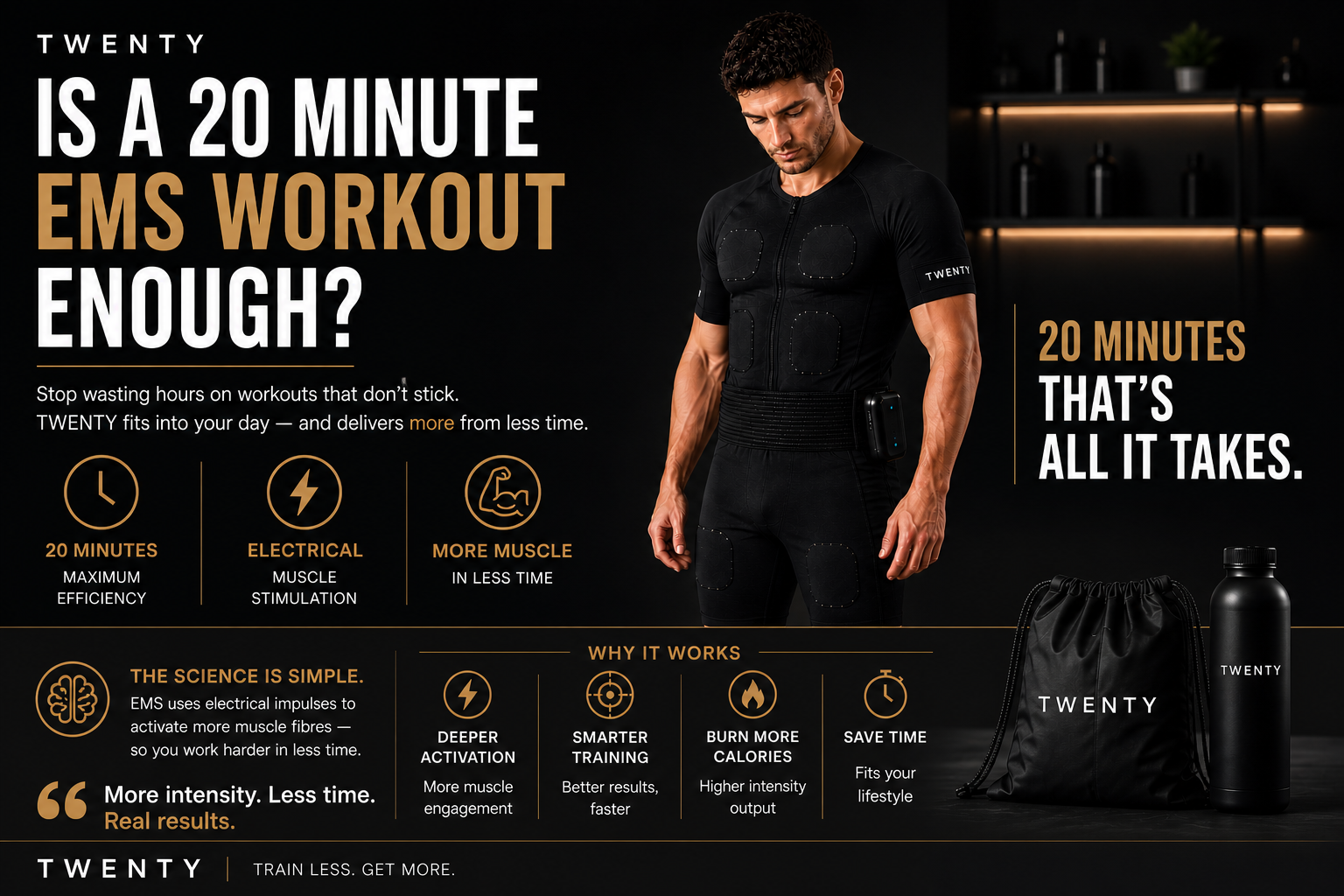
A 20 minute EMS workout combines active exercise with electrical muscle stimulation delivered through an EMS suit. The suit targets major muscle groups at once, usually including the legs, glutes, core, back, chest and arms. As you squat, lunge, hold planks or perform low-impact movements, the impulses increase muscle activation and make the session more intense.
That is the key difference. In a standard home workout, intensity often depends on equipment, load, or whether you push yourself hard enough. With EMS, the intensity is built into the system and adjusted through the app. You can tailor the session to your current level, your goals and even how you feel that day.
For someone who struggles to stay consistent, that matters. There is less friction, less guesswork and less wasted time pacing around deciding what to do next. You put the suit on, choose the mode, and train with purpose.
Why 20 minutes can feel like enough
Most people do not lack information about fitness. They lack time, energy and a routine they can repeat. A shorter session works because it lowers the barrier to starting. When a workout only asks for 20 minutes, it is easier to fit into real life and far harder to keep postponing.
EMS adds another advantage. Because multiple muscle groups are engaged at the same time, the workload is concentrated. That does not mean every 20-minute session automatically equals hours in the gym. Claims like that flatten the nuance. The better way to look at it is this: a short EMS session can deliver a very high training stimulus in a very small window, especially for general fitness, toning, consistency and body confidence.
If your usual alternative is skipping the gym entirely, a focused EMS session is not just enough. It is a serious upgrade.
What results can you expect from a 20 minute EMS workout?
The answer depends on your starting point, your effort and how regularly you train. If you want visible change, consistency still matters more than novelty. A 20 minute EMS workout done once and forgotten will not do much. Done two or three times a week, combined with sensible eating and decent recovery, it can support fat loss, muscle tone, strength and better energy.
Many people notice the first win before the mirror changes - they feel switched on again. Workouts become manageable instead of overwhelming. They stop negotiating with themselves about finding a full hour. That shift is not small. It is often the difference between another failed attempt and a routine that actually sticks.
Physical results vary. If your goal is improved muscle tone and a leaner look, EMS can be a strong fit. If your goal is elite strength performance or sport-specific conditioning, 20-minute EMS sessions may be part of the picture rather than the whole plan. It depends on what you are training for.
Who the 20 minute EMS workout suits best
This style of training makes the most sense for people who want efficiency without losing structure. Busy professionals, parents, frequent travellers and anyone tired of inconsistent gym habits tend to get the most value from it. It is especially useful for people who want guided intensity at home without needing a room full of kit.
It also suits those who find long sessions mentally draining. There is something powerful about knowing the session will be over in 20 minutes, while still feeling that you have trained properly. That confidence builds momentum.
For beginners, EMS can feel surprisingly accessible because the training is adjustable. You do not need advanced gym knowledge to get started. You do, however, need to respect the intensity. Starting at a sensible level and building up matters more than trying to prove a point in the first session.
When 20 minutes is not the full answer
Short, efficient training is appealing, but honesty matters. A 20 minute EMS workout is not a magic fix for every goal. If you are preparing for a marathon, training for a contact sport, or chasing highly specific performance targets, you will probably need additional work around endurance, technique or heavy loading.
There is also the lifestyle piece. No training method can outwork poor sleep, constant stress and a diet that does not support your goals. EMS can help you make better use of your time, but it cannot replace the basics entirely.
That said, many people do not need a perfect plan. They need a realistic one. If a shorter, high-efficiency workout is the option you can maintain through busy weeks, that is often far more valuable than a traditional programme you abandon after ten days.
How to make your 20 minute EMS workout count
The biggest mistake is treating short training like a shortcut you can do half-heartedly. Twenty minutes works when it is intentional. Choose a goal for the session. Push with good form. Recover properly afterwards.
Start by picking the right mode for what you are trying to achieve, whether that is fat burn, muscle build, cardio or recovery-focused movement. Then match the intensity to your level. Too low and you blunt the effect. Too high and your form can suffer, especially if you are new.
It also helps to think beyond the session itself. Hydration, protein intake, sleep and regularity all influence what you get back. High-efficiency training still relies on the same principles as any effective fitness plan. The difference is that it trims the dead time and brings more focus into each minute.
If you are using a connected system like TWENTY Fitness, the app-based controls make that process simpler. You can adjust muscle groups, personalise intensity and move between training modes without turning the workout into a technical project. That matters when convenience is one of the main reasons you chose EMS in the first place.
20 minute EMS workout vs traditional training
This is not a battle where one method wins for everyone. Traditional training still offers huge benefits, especially if you enjoy lifting, classes, running or sport. The issue for many adults is not whether those methods work. It is whether they fit their life often enough to create results.
A gym session can easily become a 90-minute commitment once you factor in travel, changing, waiting for equipment and getting home. A 20 minute EMS workout strips that down. It offers structure, intensity and convenience in one session, which is why it appeals to people who are done with stop-start fitness.
The trade-off is that some people enjoy the ritual and variety of longer training. Others want more social motivation or the satisfaction of heavier strength work. EMS is not here to replace every form of exercise. It is here to solve a very common problem: not enough time to train consistently.
The real value of training in 20 minutes
The best workout is not the one that sounds hardest. It is the one you can return to next week, and the week after that. That is where this approach earns its place.
A 20 minute EMS workout gives you a way to train when life is busy, your energy is limited and your old routine no longer fits. It respects the reality of modern schedules without lowering the standard of effort. You still have to show up. You still have to put the work in. But the path is cleaner, faster and easier to repeat.
If your biggest obstacle has been finding time, start there. Twenty minutes done properly can change more than your calendar. It can rebuild the habit, the confidence and the feeling that fitness fits your life again.