How to Tone Muscles at Home in 20 Minutes
The mirror rarely lies, but it can be misunderstood. If you want to know how to tone muscles at home, the goal is not a secret exercise or punishing daily workout. It is to build enough muscle to create shape, lower body fat where needed, and repeat a plan you can actually keep. For busy people, 20 focused minutes done consistently will beat a one-hour session you never have time to start.
What “toned” muscles really means
Muscles do not switch from untone to toned. What most people call a toned look is the combination of stronger, more defined muscle and the right level of body fat for that definition to show. Your shoulders look sharper, your arms feel firmer, your legs have more shape, and your core feels more stable.
That means endless light reps are not the whole answer. You need resistance that challenges your muscles, whether it comes from bodyweight, resistance bands, dumbbells or an EMS training suit. You also need movement outside your workout, enough protein, sleep, and patience.
The trade-off matters. If fat loss is your main priority, nutrition and daily activity will make a bigger difference to visible definition. If you are already lean but feel soft or weak, progressive strength training should take centre stage. Most people need both, without turning their week into a second job.
The home training formula that creates definition
A strong at-home routine has three jobs: challenge your major muscle groups, raise your heart rate occasionally, and give your body time to adapt. You do not need a room full of equipment. You need a plan with progression.
Train two to four times a week, depending on your starting point and schedule. Begin with two full-body sessions if you are new or returning after a break. Add a third session once your recovery feels solid. Training every day can work for lighter movement, but hard strength work needs recovery to produce results.
For each exercise, choose a variation that makes the final few repetitions feel demanding while your form stays controlled. If you can comfortably complete 20 repetitions, slow the movement down, add resistance, increase the range of motion or choose a harder variation. That is how your body gets the message to adapt.
Focus on the movements that matter
You can cover almost your entire body with a squat, a hinge, a push, a pull and a core exercise. A squat might be a bodyweight squat, split squat or sit-to-stand from a chair. A hinge could be a glute bridge, Romanian deadlift with dumbbells, or a hip hinge using a band.
For pushing, use incline press-ups against a worktop, knee press-ups or full press-ups. For pulling, a resistance-band row is ideal. If you do not have bands or weights, use a loaded backpack for rows, squats and hinges. The weight does not need to be fancy. It needs to be safe, stable and challenging.
Core work should train control, not just create a burn. Dead bugs, planks, side planks and slow mountain climbers teach your trunk to resist movement while the rest of your body works. That strength carries into better posture, more confident movement and stronger lifts.
A 20-minute plan to tone muscles at home
This session is designed for real life: a gap before work, the time between school drop-off and your first call, or the moment you would usually scroll on the sofa. Aim for three rounds. Rest for 20 to 40 seconds between exercises if needed, and up to one minute between rounds.
Start with two minutes of easy movement: march on the spot, circle your arms, perform gentle hip hinges and practise a few shallow squats. Then work through the following circuit for 40 seconds per exercise, followed by 20 seconds to reset:
- Squats or split squats
- Incline press-ups or floor press-ups
- Glute bridges or weighted hip hinges
- Resistance-band rows or backpack rows
- Plank shoulder taps or dead bugs
After two weeks, make one small upgrade. Add a fourth round, increase your work interval to 45 seconds, use a heavier backpack, or move from incline press-ups to a lower surface. Change one variable at a time so you can tell what is improving.
Use EMS as a training multiplier, not a replacement for effort
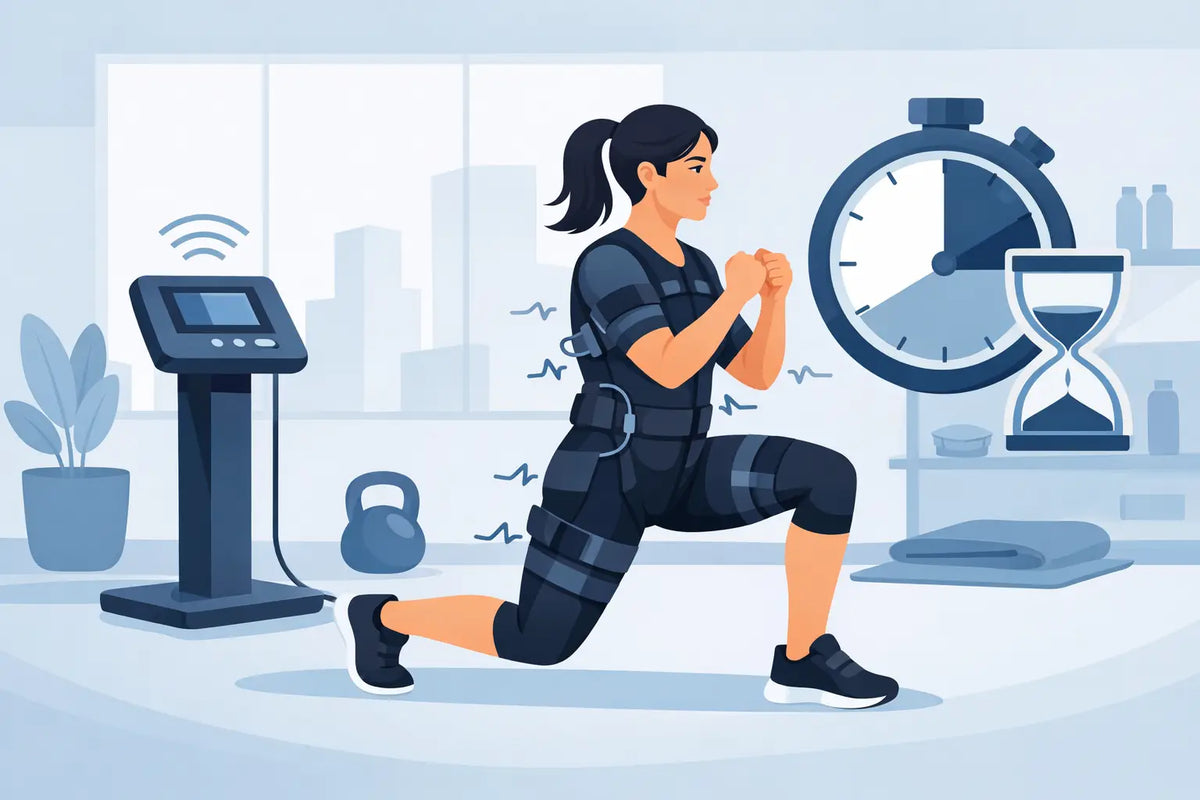
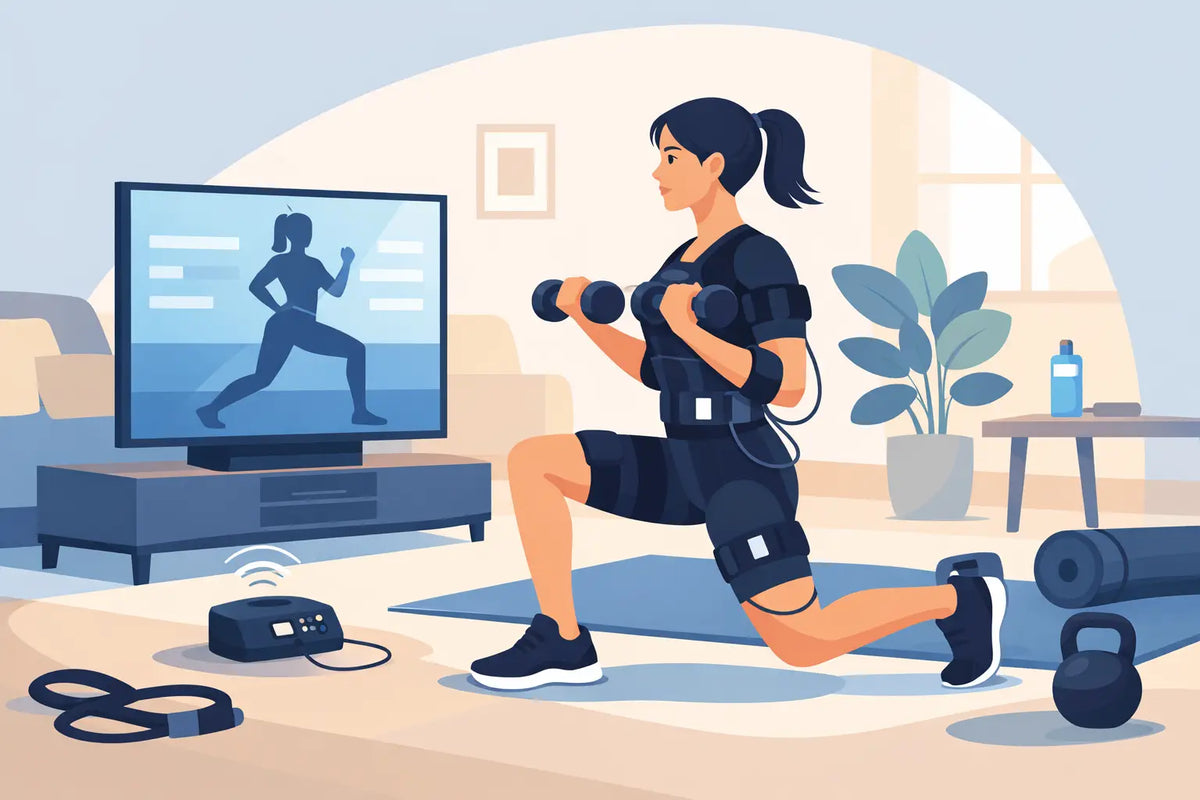
Electrical Muscle Stimulation can add targeted intensity to a home session by stimulating selected muscle groups while you move. For people with limited time, that can make simple exercises feel more demanding and purposeful without adding another hour to the day.
A system such as TWENTY Fitness lets you control intensity and choose modes through an app, so you can pair a guided session with squats, lunges, core work or low-impact cardio. It is particularly useful when you need structure and a clear reason to press start.
But smart training still applies. Start at a manageable intensity, learn how your body responds, and prioritise clean movement over chasing the highest setting. EMS is a powerful tool to support your effort, not permission to ignore recovery, nutrition or technique. If you are pregnant, have a pacemaker or other implanted electronic device, epilepsy, a heart condition, or a health concern, get medical advice before using EMS.
Eat and recover for the result you want
Training creates the signal. Recovery is where your body responds to it. If your goal is visible muscle definition, include a protein source in each meal: eggs, yoghurt, fish, lean meat, tofu, beans or lentils all count. Protein supports muscle repair and helps meals feel more filling.
Do not crash diet your way to a toned look. Extremely low calories can make training feel flat, reduce your ability to build muscle and make consistency harder. A modest calorie deficit may help if you want to lose fat, but the right approach depends on your starting point, hunger levels, activity and health needs.
Sleep is not optional background noise. Poor sleep can leave you hungrier, less motivated and less able to train with quality. Aim for a reliable bedtime more often than a perfect routine every night. Even an extra 30 minutes can change how your next workout feels.
Daily movement also deserves credit. A walk at lunch, taking the stairs, stretching between meetings and playing with your children all raise your total activity without demanding another formal workout. This is often the missing piece for people who train hard twice a week but sit for most of the rest of it.
Track strength, not just the scales
The scales can move slowly while your body changes quickly. Instead of judging every week by one number, track signs that your training is working. Your press-ups may feel cleaner. Your squat may go deeper. Your jeans may fit differently. You may have more energy at 4 pm and less hesitation when you catch your reflection.
Take a photo in similar lighting every four weeks if that feels helpful, and make a note of your exercise variations, repetitions and resistance. Progress you can see on paper is easier to trust when motivation dips.
Perfection is not the target. A missed session is just a missed session, not proof that you have failed. Train again at the next available opportunity, keep the workout short enough to fit your life, and let each completed session build the version of you that feels strong, capable and at home in your own body.