How EMS Suits Work and Why They Feel Intense
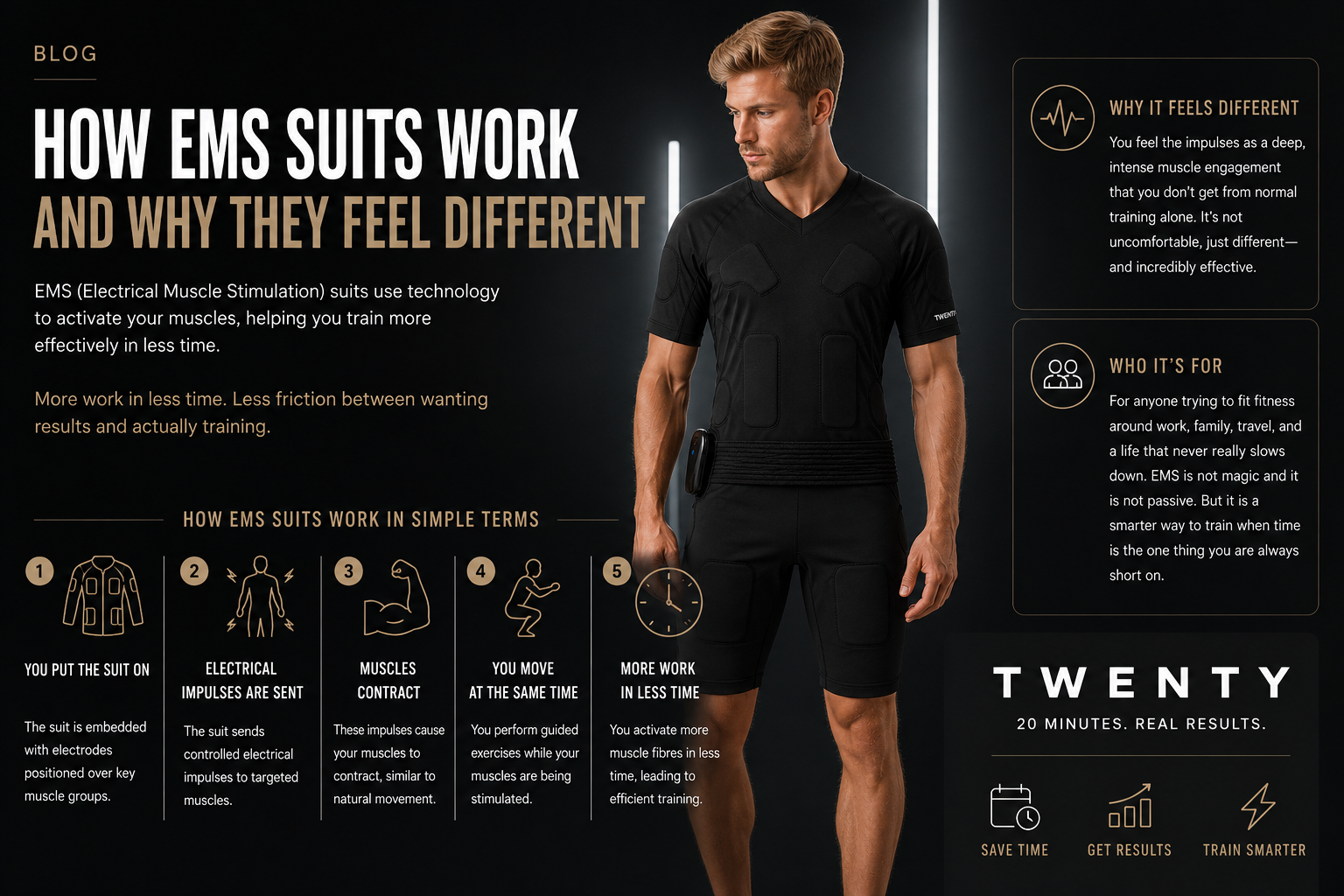
You put the suit on, start a session, and within seconds your muscles are working harder than a standard home workout usually asks of them. That is the short version of how EMS suits work. The better version is this: the suit sends controlled electrical impulses to targeted muscle groups, which causes those muscles to contract while you move through guided exercises. More work in less time. Less friction between wanting results and actually training.
For anyone trying to fit fitness around work, family, travel, and a life that never really slows down, that matters. EMS is not magic and it is not passive. But it is a smarter way to train when time is the thing you are always short on.
How EMS suits work in simple terms
EMS stands for Electrical Muscle Stimulation. Your body already uses electrical signals to make muscles contract. Every time your brain tells your legs to squat or your core to brace, that message travels through your nervous system as an electrical impulse.
An EMS suit adds an external version of that signal. Electrodes built into the suit sit over key muscle groups such as the abs, glutes, thighs, chest, back, arms, and lower body. When the system is switched on, those electrodes deliver low-frequency impulses that encourage the muscles to contract.
That is the core idea behind how EMS suits work. You are still exercising, but the suit increases the training demand by recruiting more muscle fibres at the same time. A bodyweight squat can feel far more demanding when your quads and glutes are also being stimulated by the suit.
The result is a session that feels efficient from the first minute. You are not spending half your workout getting into the right mindset or waiting for the hard bit to start. The hard bit starts quickly.
What happens when you wear an EMS suit
Once the suit is fitted properly, each muscle area can be activated through a connected controller or app. Good systems let you adjust intensity by muscle group rather than blasting everything at the same level. That matters because your glutes may handle a stronger stimulus than your arms, and your core may need a different setting again.
Most sessions follow a pulse pattern. The suit sends impulses for a few seconds, then eases off briefly, then repeats. During the work phase, you perform movements such as squats, lunges, presses, twists, or holds. During the rest phase, you reset and prepare for the next contraction.
This rhythm is one reason EMS training feels so different from a normal workout. There is a clear on-off cycle, and when the pulse hits, you feel your muscles switch on more forcefully. Not painful when used correctly, but definitely noticeable. Intense in a focused, controlled way.
With modern home systems, the experience is also more personalised than many people expect. You are not locked into one generic setting. You can choose modes based on your goal, whether that is cardio support, fat burn, muscle-building, recovery, or lower-intensity work. That flexibility is a big part of why EMS has moved beyond clinic use and into everyday training.
Why the contractions feel stronger
The main reason EMS feels powerful is recruitment. In a standard workout, the number of muscle fibres involved depends on the movement, your effort, your form, and your fatigue level. With EMS, the electrical impulse prompts additional contraction on top of the voluntary movement you are already doing.
Think of it as layering. Your body initiates the movement, then the suit adds another training signal. That can increase muscle engagement and make simple exercises feel much tougher than they look.
This is also why 20 minutes can feel like a serious session. The suit does not replace effort. It compresses it. If you move well and keep the intensity appropriate, you can create a lot of muscular demand in a shorter window than traditional training usually requires.
There is a trade-off, though. Because the contractions are more intense, beginners should not start too aggressively. More is not always better in week one. The smarter approach is progressive. Let your body adapt, build consistency, then increase intensity over time.
Which muscles do EMS suits target?
A full-body EMS suit is designed to stimulate multiple major muscle groups at once. That usually includes the abdominals, obliques, lower back, glutes, thighs, upper arms, chest, and upper back. Some systems offer more precise control than others, which is useful if you want to prioritise certain areas or reduce intensity somewhere that feels too strong.
This full-body approach is one of the reasons people are drawn to EMS in the first place. In a normal session, you might train legs one day and upper body another. With EMS, you can engage a wide range of muscle groups in the same workout. That makes the training feel time-efficient and purpose-built for busy schedules.
Still, the quality of movement matters. If you simply stand there and expect the suit to do everything, results will be limited. EMS works best when combined with active exercise, controlled technique, and a plan you can stick to.
How EMS suits work for different fitness goals
The same technology can support different outcomes depending on how you use it. That is where training mode, intensity, and session structure come in.
If your goal is muscle tone and strength, the suit can be used with slower, more controlled resistance-style movements. The stronger contractions increase the demand on working muscles, which can help make short sessions feel productive.
If fat loss is the priority, EMS can be paired with dynamic circuits that keep the heart rate up while still challenging the muscles. That combination appeals to people who want efficient sessions without long hours of cardio.
If recovery or mobility is the focus, lower-intensity settings may be used to encourage blood flow and support lighter movement. Not every EMS session has to be all-out. Sometimes the smartest session is the one that helps you stay consistent without burning out.
That is the real advantage. EMS is adaptable. Your training can meet you where you are rather than forcing you into a one-size-fits-all routine.
Is EMS training actually effective?
Used properly, yes. But effectiveness depends on expectations and behaviour.
EMS can make training more efficient by increasing muscle activation and reducing the amount of time needed to create a meaningful training stimulus. For people who struggle to fit in regular gym sessions, that can be a genuine game-changer. A short, structured workout at home is easier to repeat than a 90-minute plan that keeps getting pushed to next week.
What EMS cannot do is override poor habits everywhere else. If sleep is a mess, movement outside workouts is low, and nutrition is completely disconnected from your goal, the suit will not carry the whole result on its own. It is a powerful tool, not a free pass.
The people who tend to do best with EMS are not necessarily fitness fanatics. They are often busy adults who need fewer barriers, clearer structure, and something that makes short sessions count. That is where a connected system like TWENTY fits naturally - guided, adjustable, and built for real life rather than ideal conditions.
What EMS feels like for first-time users
The first sensation usually surprises people. It feels like a pulsing tightening of the muscles rather than a surface-level buzz. As intensity rises, the contractions become stronger and more deliberate. Your body feels switched on.
Most first-time users also realise quickly that small movements become challenging. A hold, a squat, or a lunge can feel much tougher when the suit is firing through the working muscles. That is normal. It does not mean something is wrong. It means the training stimulus is different from what your body is used to.
You may feel muscle soreness afterwards, especially in the early sessions. Again, normal. EMS asks a lot of your muscles, so recovery matters. Hydration, rest, and sensible progression all help.
Who benefits most from understanding how EMS suits work?
Usually the person who has tried to get fit five times and stopped because life got in the way. The parent squeezing training between school runs and work calls. The professional who wants results but cannot keep pretending they have an extra hour every evening. The person who is tired of starting over.
Understanding how EMS suits work helps cut through the hype. You see what the suit is actually doing, what your role still is, and why the method can be so effective when used properly. It is advanced technology, yes, but the value is practical. You train hard, you save time, and you give yourself a system you are more likely to stick with.
That is what makes EMS compelling. Not because it promises shortcuts without effort, but because it respects reality. If your life is full, your training needs to be sharper. And when a method helps you feel stronger, more energised, and more in control in just 20 minutes, that is not a gimmick. That is a reason to start.