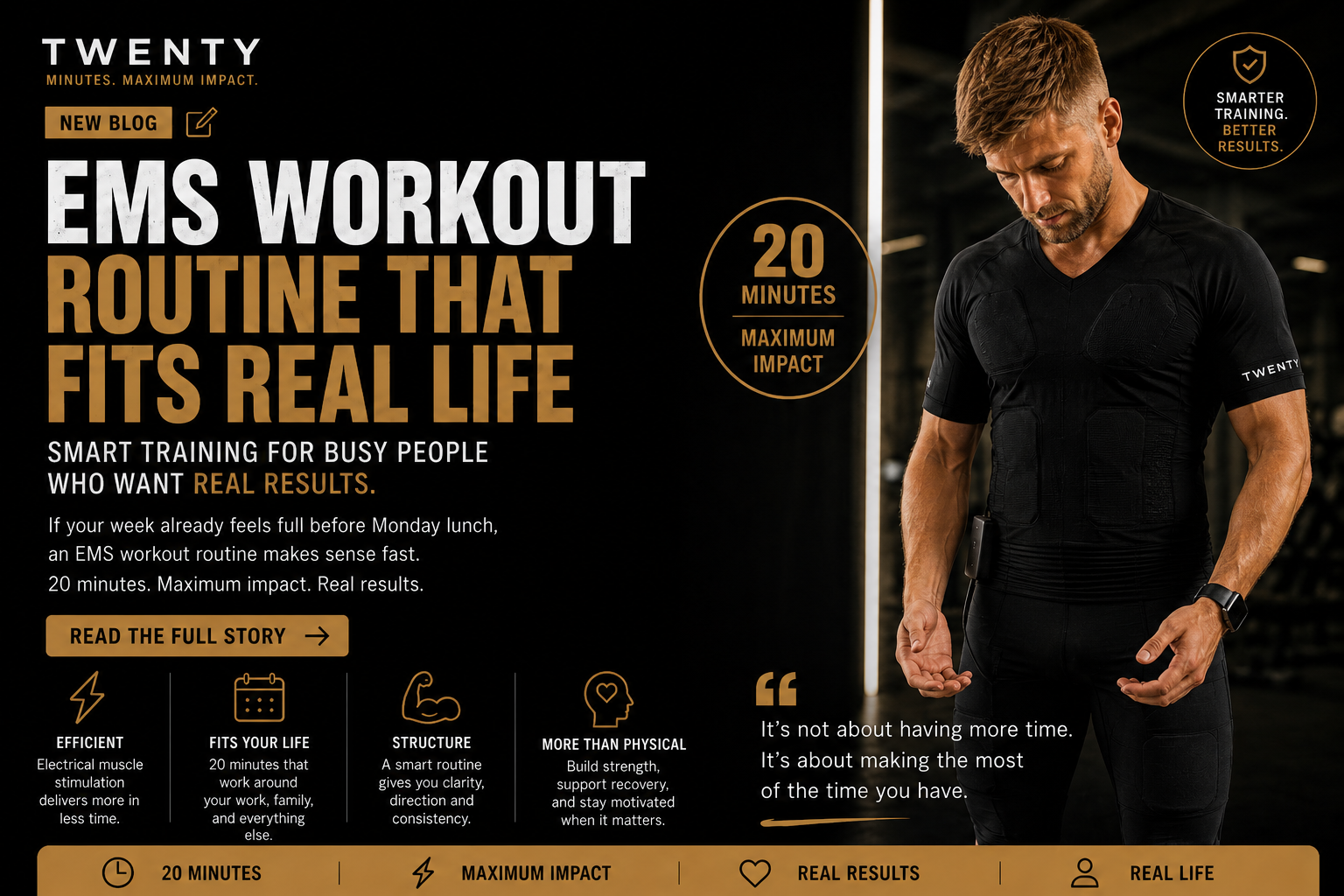
EMS Workout Routine That Fits Real Life
If your week already feels full before Monday lunch, an EMS workout routine makes sense fast. You are not trying to become someone who spends hours in the gym. You want a system that fits around work, family, travel, and the hundred small things that usually push training to the bottom of the list. That is exactly why EMS works so well when the routine is set up properly.
The key word is properly. Electrical muscle stimulation is efficient, but it is not magic. A smart routine gives you structure, enough recovery, and a clear reason to keep going when motivation dips. Get that right, and 20 minutes starts to feel less like a compromise and more like a serious plan.
What makes an EMS workout routine different?
A traditional training plan usually asks for more time, more equipment, and more mental effort. You need to decide what to train, how many sets to do, whether to go heavier, and how to fit cardio around it. For busy people, that decision-making alone can become a barrier.
An EMS workout routine strips that back. The suit stimulates multiple muscle groups while you move through guided exercises, so a short session can feel surprisingly complete. Instead of chasing volume for the sake of it, you focus on quality, intensity, and consistency.
That does not mean every session should be brutal. In fact, one of the biggest mistakes people make with EMS is assuming harder is always better. Your body still needs time to adapt. Your muscles still need recovery. And your routine should match your goal, not your guilt.
Start with your real goal, not your ideal fantasy
Most people do not need a complicated programme. They need one they will actually follow for the next eight weeks.
If your goal is fat loss, your EMS sessions should keep you moving, elevate effort, and support consistency across the week. If your goal is muscle tone, your routine should use more controlled movements, enough stimulus, and steady progression in intensity. If your goal is simply to rebuild fitness after a long stop-start period, the best plan is often the simplest one.
Be honest here. If you know you can commit to two sessions a week, build around two. A routine that looks impressive on paper but falls apart after ten days is not ambitious. It is inefficient.
How often should you do EMS workouts?
For most people, two to three EMS sessions per week is the sweet spot. That is enough to create momentum and visible progress, without tipping into the kind of fatigue that makes you want to skip the next session.
If you are new to EMS, start with two sessions a week for the first two to three weeks. That gives your body time to adjust to the stimulation and helps you learn how different intensity levels feel across each muscle group. Once that feels manageable, many people can move to three sessions weekly depending on recovery, sleep, and overall activity.
More is not automatically better. If you are already stressed, underslept, or juggling a demanding schedule, pushing too hard can backfire. A sustainable routine always wins.
A simple weekly EMS workout routine
The best routine is one that removes friction. You should know what you are doing before the week starts.
Option 1: For fat loss and general fitness
Train on Monday and Thursday, or Tuesday and Friday. Leave at least one full day between sessions.
In each 20-minute workout, start with a short warm-up and moderate stimulation. Then move into a mix of squats, lunges, step-backs, standing core work, presses, rows, and light cardio bursts such as marching, fast feet, or low-impact knee drives. Finish with a brief recovery or relaxation mode if your system includes one.
This style works well because it keeps the whole body engaged and fits busy schedules. It is also easier to stay consistent with than a split routine when life gets messy.
Option 2: For muscle tone and strength focus
Train two or three times per week with a slightly slower pace. Use movements with more control and longer tension, such as squat holds, glute bridges, split squats, push patterns, rows, and anti-rotation core work.
With EMS, the sensation can make even simple movements feel much more demanding. That is the point. You do not need endless reps. You need clean movement, the right intensity, and enough recovery to come back strong.
Option 3: For rebuilding consistency
If you have fallen out of routine, keep week one almost too easy. One or two sessions. Lower intensity. Basic movements. Finish feeling capable, not crushed.
This matters more than people think. Early wins build trust. When your training feels manageable, you are far more likely to repeat it next week.
How to structure each 20-minute session
A strong EMS session should feel purposeful from the first minute. You are not wandering between exercises or checking the clock every 30 seconds.
1. Warm up and switch on
Spend the first few minutes waking the body up. Think bodyweight squats, arm circles, hip openers, glute activation, and light marching on the spot. Keep the stimulation lower at this stage so you can settle into the session.
2. Main working block
This is where the routine earns its place. Choose four to six movements that train the whole body and repeat them in controlled rounds. Squats, lunges, hinges, presses, rows, and core work give you the most return for your time.
If your app allows muscle group control, match the settings to the movement. That makes the workout feel more targeted and helps you avoid using maximum intensity everywhere just because you can.
3. Finisher or focus block
Use the last few minutes to support your main goal. For fat loss, that might be short cardio intervals. For muscle tone, it might be slower glute or core work. For recovery days, it could be mobility and lower-intensity stimulation.
4. Cool down
Do not skip this because the session is short. A minute or two of slower movement, breathing, and recovery mode can make the next day feel much better.
The biggest mistakes with an EMS workout routine
The first is turning every session into a test. If you chase the highest intensity every time, form usually drops and recovery suffers. Better results come from progression, not punishment.
The second is changing too much too often. People love novelty, but your body responds well to repeated patterns done properly. Keep the routine stable long enough to improve within it.
The third is expecting EMS to cancel out everything else. It is powerful, but it still works best when supported by decent sleep, enough water, and a realistic approach to food. If your energy is low and recovery is poor, your routine will feel harder than it needs to.
How to know if your routine is working
Results are not only about the scales. A good EMS routine often shows up first in smaller ways. Your clothes fit better. Stairs feel easier. You feel more switched on in the afternoon instead of flat. You stop having that constant start-again-on-Monday conversation with yourself.
Visible changes can come with consistency, but timelines vary. It depends on your starting point, your training frequency, your nutrition, and how hard you are genuinely working during each session. The honest answer is that some people notice changes in a few weeks, while others need longer. What matters is whether the routine is repeatable enough to carry you through that period.
Making EMS work in real life
This is where most routines win or lose. A great plan on paper still fails if it asks too much from a normal week.
Schedule sessions when you are most likely to keep them. For some people that is before the house wakes up. For others it is a lunch break or straight after work before the sofa pulls them in. Do not wait for the perfect time. Pick the time with the least resistance.
It also helps to reduce setup friction. Keep your suit ready. Know your session in advance. Open the app and start. TWENTY Fitness is built around this idea - less faff, more action, better follow-through.
The routine should support your life, not take it over. If you miss a session, adjust and move on. One missed workout is just a missed workout. The real problem starts when one missed session turns into two weeks of doing nothing.
When to push and when to pull back
Some weeks you will feel strong and ready to increase intensity. Good. Use that. Other weeks, work stress, poor sleep, or family chaos will change the picture. That does not mean stop. It means train intelligently.
A lighter EMS session still counts. A shorter session still protects the habit. Progress is rarely a straight line, especially for busy adults. The win is staying in motion.
The best EMS workout routine is not the one that looks hardest online. It is the one you can trust when life is busy, your energy is mixed, and you still want results. Keep it simple, keep it structured, and let consistency do the heavy lifting. Twenty minutes, done well, can change far more than your calendar.