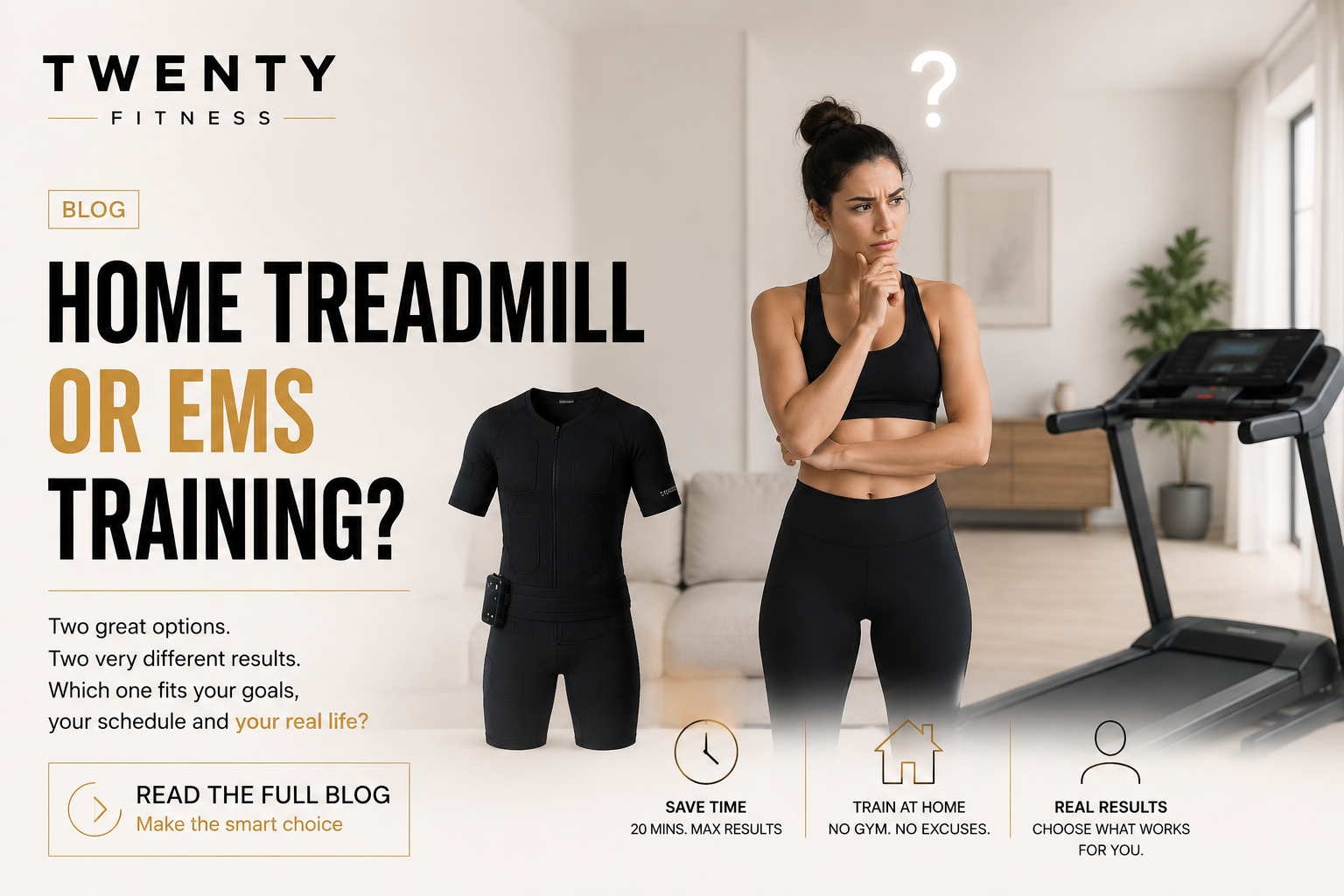
Home Treadmill or EMS Training?
You buy a treadmill with the best intentions. It arrives, takes over a corner of the spare room, gets used hard for two weeks, then life happens. Work runs late. The kids need something. Your energy drops. That is exactly why the question of home treadmill or EMS training matters - not in theory, but in real life, where consistency beats perfect plans.
If you are trying to get fitter at home, both options can help. But they solve very different problems. A treadmill gives you familiar cardio on demand. EMS training is built for people who want more from less time. The right choice depends on your goals, your schedule and how much friction you can realistically tolerate.
Home treadmill or EMS training: what are you really choosing?
At first glance, this looks like a simple cardio-versus-tech decision. It is not. You are choosing a training experience, a time commitment and a style of motivation.
A home treadmill is straightforward. You walk, jog or run. It is predictable, easy to understand and useful if your main aim is getting more daily movement or improving running fitness. There is very little learning curve. Press start and go.
EMS training works differently. Electrical Muscle Stimulation sends impulses to targeted muscle groups while you move through guided exercises. That means your muscles are being activated more intensely during short sessions, often in as little as 20 minutes. For busy adults, that changes the equation fast. It is not about spending longer. It is about making each minute work harder.
Neither option is magic. But one asks for more time, and the other asks for more openness to a newer way of training.
Time is where EMS training pulls ahead
Most people do not quit fitness because they do not care. They quit because their routine asks too much of their week. This is where treadmills often lose momentum.
A treadmill session usually needs a proper block of time. Even a decent brisk walk can turn into 30 to 45 minutes once you factor in changing, warming up, cooling down and showering. If you enjoy that time, great. If your calendar already feels packed, that demand adds up quickly.
EMS training is designed for compressed schedules. A guided 20-minute session can target multiple muscle groups and support goals like toning, cardio fitness, fat loss or recovery depending on the mode you choose. That makes it easier to fit training into a lunch break, before school drop-off or between meetings.
The obvious trade-off is that a treadmill is simpler. You do not need to learn settings or get used to the feel of stimulation. But if your biggest fitness problem is lack of time, simplicity alone will not save a routine you cannot stick to.
What kind of results do you want?
This is the part people often skip. They ask which tool is better before deciding what better means.
If your goal is to improve endurance for running events, build your step count or enjoy steady-state cardio, a home treadmill makes sense. It gives you a direct way to walk or run regardless of weather, daylight or local routes. For runners especially, specificity matters. Running on a treadmill still supports running performance.
If your goal is visible body change with minimal time, EMS training has a stronger case. It combines muscle activation with guided movement, which can support muscle tone, strength, calorie burn and overall conditioning in a shorter session. For many people, that matters more than simply covering miles.
There is also the body-composition question. Treadmills are often seen as a weight-loss machine, but cardio alone does not always create the shape people want. You can burn calories, yes, but if you also want firmer legs, a stronger core and more definition, resistance and muscular engagement matter. EMS training is built with that in mind.
So ask yourself one honest question: are you trying to move more, or transform more? That answer will steer the decision.
Joint impact, recovery and how your body feels
A treadmill can be low impact or high impact depending on how you use it. Walking at an incline is usually gentler than road running, and cushioned decks can reduce some stress. Still, repetitive treadmill running can be tough on joints for some people, especially if they are carrying extra weight, coming back after a long break or managing aches in the knees, hips or lower back.
EMS training can be appealing here because it does not rely on pounding out miles. Sessions can be adapted to different fitness levels, and the workload comes from muscular stimulation combined with controlled movement rather than repeated impact. That can feel more manageable for people who want intensity without the wear and tear of long runs.
That said, EMS is still training. If intensity is set too high too soon, it can feel demanding. Good guidance and gradual progression matter. The best approach is not to prove how hard you can go on day one. It is to build consistency your body can recover from.
Motivation is more than willpower
A lot of home fitness equipment fails for one reason: it becomes furniture. Not because the product is bad, but because motivation is fragile when the workout feels repetitive.
Treadmills can absolutely become monotonous. Some people love zoning out with a podcast or getting steps in while watching a series. Others find the experience dull within days. If you already struggle with boredom, that matters. The best workout is the one you will actually repeat.
EMS training tends to feel more structured and interactive. You are not just doing time. You are following a programmed session, adjusting intensity, targeting muscle groups and working towards a focused result. That sense of progression can make it easier to stay engaged, especially for people who like feeling that a workout has a clear purpose.
This is one reason tech-led training works well for busy adults. It reduces decision fatigue. You do not have to wonder what to do for 45 minutes. You start the session, follow the guidance and finish knowing you have done something meaningful.
Space, noise and everyday practicality
Let us be honest. A treadmill is a commitment. Even folding models take up floor space, and many are heavier and bulkier than expected. They also make noise. If you live in a flat, share your space or train early in the morning, that can become a genuine issue.
EMS training is lighter on the home. You are not dedicating a permanent footprint to one machine. That matters if your home has to function as office, family base and place to unwind all at once. Convenience is not just about workout time. It is also about whether your setup fits your life without taking it over.
This is where a modern EMS system feels less like equipment and more like a flexible training solution. It adapts to your schedule and your space instead of demanding both.
Cost matters, but so does value
People often assume a treadmill is the safer investment because it is familiar. Sometimes it is. But value is not just about purchase price. It is about use.
A treadmill that gets used three times a year is expensive, no matter what you paid. An EMS system that becomes part of your weekly routine can deliver more return simply because it solves the real problem: staying consistent.
There is also the question of variety. A treadmill mainly offers one movement pattern with changes in pace and incline. EMS training can support cardio, muscle work, fat burn, recovery and different training styles through guided modes and adjustable settings. For someone who wants one at-home system to cover more ground, that flexibility counts.
So, should you choose a home treadmill or EMS training?
Choose a treadmill if you genuinely enjoy walking or running, want to improve endurance and know you will use it regularly. If movement itself is your main goal and you like familiar equipment, it can be a solid fit.
Choose EMS training if your life is busy, your time is limited and you want a faster route to visible, full-body results. It makes more sense for people who need efficiency, structure and a training method that works around real schedules rather than ideal ones.
For many adults, that is the real decision. Not what sounds impressive. What will still fit next month when work is hectic, your motivation dips and the easy option is doing nothing.
That is why more people are moving towards smarter, shorter training instead of simply longer sessions. TWENTY Fitness speaks directly to that shift. When a workout can fit your day instead of fighting it, consistency stops feeling like a battle.
Pick the method that removes excuses, not the one that adds more effort to an already full week. The best plan is the one you can live with long enough to feel great again.