Article: EMS vs gym workouts: Which fits you?
EMS vs gym workouts: Which fits you?
You do not fail at fitness because you lack motivation. More often, you fail because your plan asks for more time, travel, and mental effort than your life can realistically give. That is why EMS vs gym workouts is such a useful comparison. It is not just about calories or kit. It is about what you can actually stick with when work runs late, the kids need you, and your energy is already stretched.
The truth is simple. Both methods can work. Both can help you get stronger, leaner, and more confident. But they work in very different ways, and the best choice depends less on theory and more on your routine, goals, and tolerance for friction.
EMS vs gym workouts: the real difference
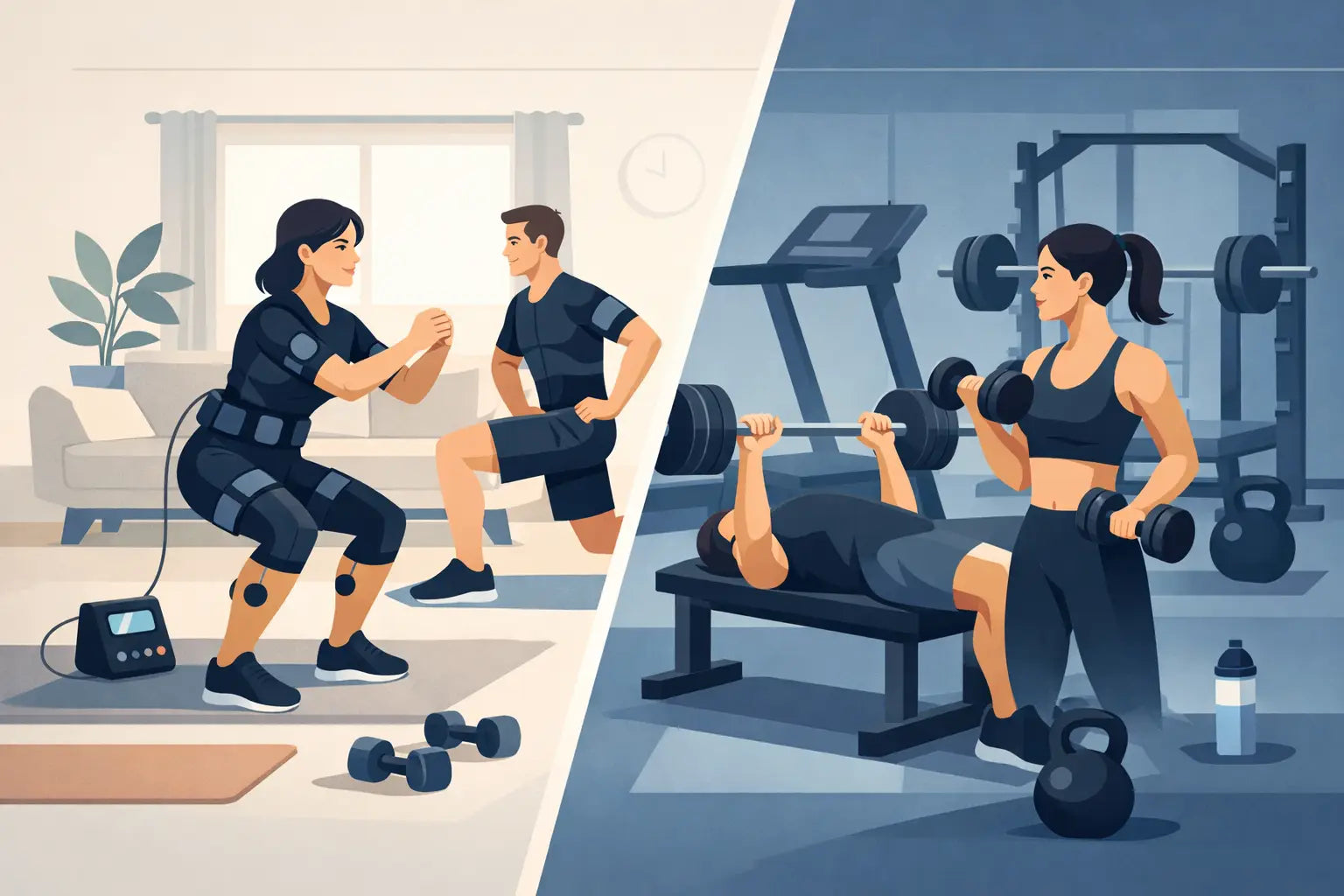
A traditional gym workout relies on external resistance and repeated movement patterns. You lift weights, use machines, row, cycle, run, or follow classes. Your muscles contract because your brain tells them to and the equipment creates load.
EMS training adds electrical muscle stimulation to the equation. In an EMS suit, targeted impulses trigger muscle contractions while you perform guided movements or training sequences. The aim is not to replace movement altogether. It is to make each movement work harder in less time.
That difference matters. A gym session often gives you variety, heavier loading, and a familiar training environment. EMS gives you efficiency, low setup friction, and a more controlled at-home experience. One is built around the gym routine. The other is built around modern life.
What results can you expect?
If your goal is general fitness, fat loss support, muscle tone, and consistency, both can get you there. The gap usually comes down to how regularly you train and how intense those sessions are.
Gym workouts are excellent for progressive overload. If you want to build serious strength, increase your squat, deadlift, or bench numbers, or train for sport, the gym still has a clear edge. Heavy barbells and machines let you add load in a way EMS cannot fully replicate.
But most people are not training for a powerlifting meet. They want to look better, feel stronger, have more energy, and stop starting over every few weeks. That is where EMS becomes very compelling. Because the muscle activation is high and the sessions are short, many busy adults find it easier to train consistently. And consistency changes everything.
A brilliant workout plan that happens once a week will lose to a smart 20-minute routine you actually complete.
When the gym wins
The gym makes most sense if you genuinely enjoy training there, have time to travel, and want full equipment access. It is also better if your goals are highly specific, such as maximal strength, bodybuilding volume, or performance training.
It can also suit people who thrive on atmosphere. Some need the structure of a dedicated space, the buzz of other people training, or the ritual of leaving the house to switch into workout mode.
When EMS wins
EMS works best when time is the main barrier. If you are juggling work, family, commuting, and everything else, the biggest challenge is often not effort. It is logistics. An at-home system removes changing rooms, travel time, waiting for machines, and the decision fatigue that kills momentum.
For people who want visible progress without building their week around the gym, EMS is a strong fit. It can also feel less intimidating for anyone put off by crowded gym floors or overly complicated programmes.
Time efficiency is not a small detail
This is where the comparison gets serious. A gym workout is rarely just the workout. It is getting ready, travelling there, checking in, warming up, waiting for equipment, cooling down, showering, and travelling back. A 45-minute session can quietly eat 90 minutes or more.
EMS changes that equation. When training is built around a suit and app-based control, the whole process becomes tighter. You can train at home, target specific muscle groups, choose a mode that matches your goal, and finish before a traditional gym session would even be halfway done.
That is not laziness. That is smart design. If your life is full, efficiency is not a bonus. It is the difference between staying on track and dropping off.
Effort feels different in each method
Some people assume EMS is an easy option. It is not. Short does not mean soft.
An effective EMS session can feel intense because multiple muscle groups are being stimulated at once while you move through controlled exercises. You may spend less total time training, but the work inside those minutes is focused.
Gym effort is different. It often includes longer sessions, more rest periods, and more variation in intensity. You might push hard for a heavy set, then recover, then move to another exercise. That can be fantastic, but it also creates more room for drift. A lot of gym sessions look productive without actually being that demanding.
With EMS, there is less hiding. The session tends to be more structured, more direct, and easier to complete without wasting time.
Convenience drives consistency
People often talk about discipline as if it lives in your mindset alone. It does not. It also lives in your environment.
If your workout requires a drive across town, a packed bag, a free evening slot, and enough energy to deal with a busy gym, you have built a high-friction habit. High-friction habits break first.
If your workout can happen in your own space, on your schedule, with guided settings and fewer barriers, the habit becomes easier to protect. That is one reason EMS has such strong appeal for busy adults. It fits around life instead of asking life to move around it.
This is where TWENTY Fitness has positioned EMS so well. The suit, guided controls, and targeted training modes turn what could feel technical into something practical. Less guesswork. More action. That matters when your window to train is 20 minutes, not two hours.
Cost is more nuanced than it looks
At first glance, a gym membership can seem cheaper. Monthly fees may look low, especially at budget chains. But the real cost is not just the headline price. It includes travel, time, occasional parking, extra purchases, and the hidden cost of paying for something you barely use.
An EMS setup usually involves a bigger upfront investment. That can make some people pause. Fair enough. But if you use it consistently at home, the value equation changes quickly. You are paying for convenience, personalisation, and time returned to your week.
So the better question is not, which one is cheaper? It is, which one are you more likely to use enough to justify the spend?
EMS vs gym workouts for different goals
For fat loss, the winner is the method you can sustain while managing nutrition and weekly activity. The gym can support this well, but so can EMS. If shorter, high-efficiency sessions help you stay consistent, EMS may be the stronger tool in real life.
For muscle tone and body confidence, both work. EMS can be especially attractive if you want a guided, low-friction route to regular resistance-based training.
For building maximum strength, the gym still leads. Heavy external load remains the gold standard when pure strength is the target.
For rehab-style gentle reintroduction to exercise, the answer depends on the individual and should be guided properly. EMS can be useful in some contexts, but not every body or situation is the same.
For motivation, this is personal. Some people need the energy of a gym floor. Others do far better when they can train privately and remove the drama from getting started.
So which should you choose?
Choose the gym if you love the environment, want full training variety, and have the time to make it part of your week without stress. If going there feels natural rather than forced, that is worth a lot.
Choose EMS if your biggest problem is not knowledge but consistency. If you are tired of wasting weeks trying to find time for long sessions, a more efficient system can be the breakthrough. Twenty minutes done properly, done regularly, can reshape far more than your body. It can rebuild trust in yourself.
There is no medal for making fitness harder than it needs to be. The smartest workout is the one that fits your life closely enough to become part of it. Pick the method that removes excuses, keeps you moving, and helps you feel strong again. Then keep going.